How to Select High-Temperature Vacuum Suction Cups for Hot Glass
Learn how to select a felt-faced vacuum suction plate for hot glass. Compare contact temperature, dwell time, cooling intervals and surface-marking requirements before specifying the gripper.
On this page (9 sections)
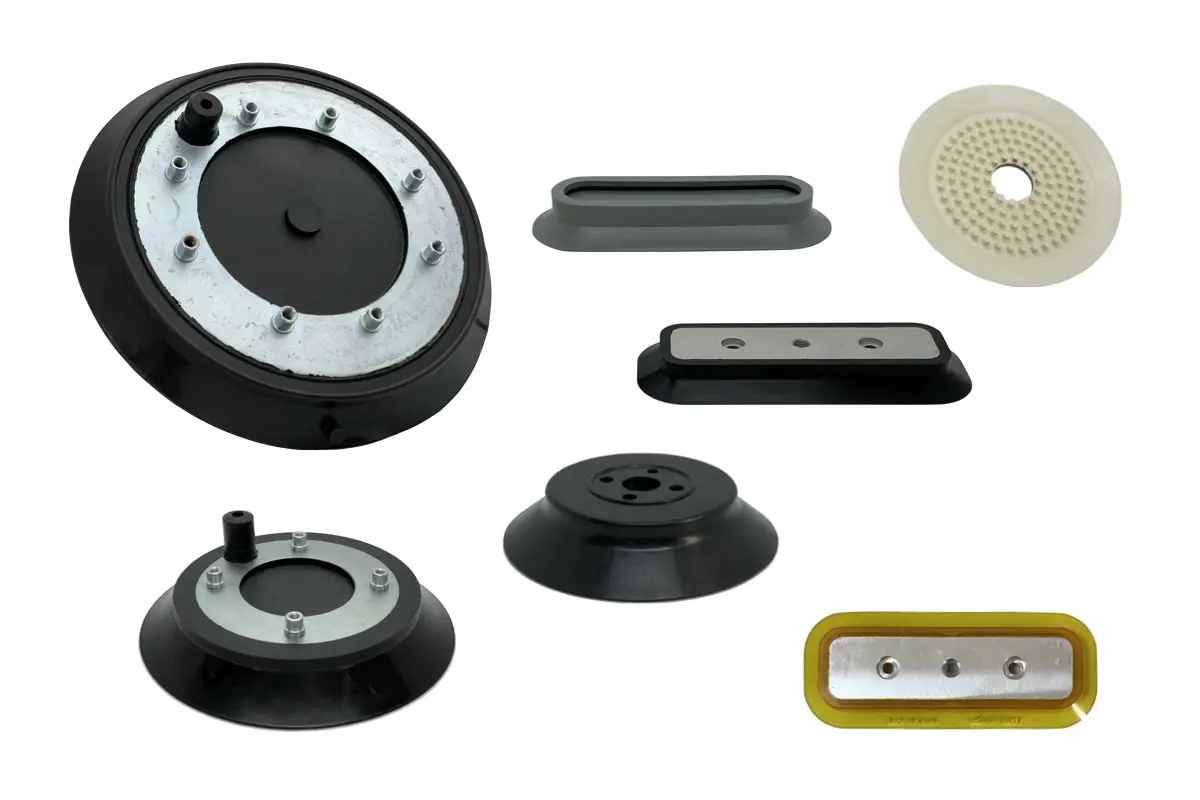
A high-temperature vacuum suction cup for hot glass must maintain a seal throughout the transfer and leave the finished surface within its inspection limits. A useful starting point is a round suction plate with a fluoroelastomer body, a heat-resistant felt contact face and a metal backing plate. Whether that construction suits a particular line depends on three measurements: the glass temperature where the cup lands, the time it stays in contact and the cooling interval before the next pickup.
1. Measure the temperature where the suction cup meets the glass
On a glass bending or tempering line, the furnace setpoint tells you how the furnace operates. The temperature that matters for gripper selection is the surface temperature at the pickup station, on the face the cup will touch. Record that value at the hottest expected pickup condition, using a measurement method suitable for the glass and its coating.
| What to record | Why it affects selection |
|---|---|
| Glass surface temperature at pickup | Establishes the thermal exposure when the sealing lip first touches the workpiece. |
| Longest contact time | Includes the transfer, positioning and any pause while the gripper holds the glass. |
| Shortest interval between release and the next pickup | Determines how much cooling time the plate has at peak production speed. |
| Backing plate temperature over successive cycles | Shows whether heat accumulates during a production run. |
| Contact face and surface finish | Identifies coating restrictions and the surface to inspect after handling. |
Consider a hypothetical transfer that holds each pane for four seconds. At one pickup every 30 seconds, the plate has 26 seconds between contacts. At one pickup every eight seconds, it has only four. The glass arrives at the same temperature in both cases, but the second cycle gives the assembly much less time to shed heat. Include both timings when requesting a temperature rating.
2. Understand the roles of FKM, felt and the metal backing plate
Fluoroelastomer (FKM/FPM). The elastomer forms the flexible part of the suction plate. Its sealing lip must follow the local glass contour closely enough to establish vacuum. When comparing compounds, request operating limits for the finished assembly, including the permitted duration of hot contact.
Heat-resistant felt. A felt facing provides a contact layer between the elastomer and the glass. This construction is worth evaluating when contact marks are a concern. Inspect the felt for trapped particles, worn patches and exposed edges. For coated glass, obtain the glass manufacturer's instructions for the specific contact face before running a trial.
Metal backing plate. A broad metal support helps spread heat away from the contact element and provides the mounting interface. Some designs use a screwed connection so the worn suction element can be replaced separately. Check access to the fastener and the temperature limits of fittings and hoses near the plate.
3. Match the sealing lip to the available glass surface
A round plate with a single sealing lip needs a continuous contact path around its perimeter. For a flat pane, identify a landing area clear of edges, holes and steps. For curved glass, check the local contour at each cup position. A larger plate can extend into an area where the glass curves away from the lip.
Document pane mass, orientation, acceleration and the available vacuum at the gripper. A vertical transfer also requires sufficient resistance to sliding at the hot contact interface. Review the proposed cup layout and holding capacity for the complete movement, including deceleration. For the preliminary force calculation, see the vacuum suction cup holding force and safety factor guide.
4. Test grip and surface quality over repeated hot cycles
A first pickup with a cool plate leaves two questions open: whether the seal remains stable as the tooling warms, and whether contact traces become visible after the glass cools. Use a controlled trial with representative workpieces and the intended production timings.
| Trial check | What to evaluate |
|---|---|
| Vacuum at pickup | Record the time needed to reach the machine's approved transfer threshold. |
| Grip during motion | Check for sliding or loss of vacuum during the most demanding part of the transfer. |
| Heat accumulation | Track backing plate temperature from a cold start through repeated cycles at the shortest cooling interval. |
| Release and surface finish | Inspect the contact locations after cooling under the lighting and acceptance criteria used for the finished glass. |
| Condition after the run | Examine the lip, felt, fastener and mounting plate. Record the cycle count and any change in pickup or release behaviour. |
Keep the cup positions on the inspection drawing. If a mark appears, its location can help distinguish a trace along the sealing lip from a particle impression within the felt contact area.
5. What to include in a hot-glass handling enquiry
Supply the glass drawing, mass, curvature and permitted contact face. Mark the proposed pickup points and include the measured surface temperature, maximum contact duration and minimum cooling interval. For an existing station, add the suction plate dimensions, mounting details and vacuum measured at the gripper.
If surface appearance is part of acceptance, include a photograph of an acceptable pane and an example of a rejected mark where available. This gives the equipment and quality teams a common reference for evaluating the trial.
Frequently asked questions
What temperature should I specify for a hot-glass suction cup?
Specify the glass surface temperature at pickup, the longest contact time and the shortest cooling interval. Check all three against the limits for the complete suction plate assembly.
Can I use a short-term contact rating for repeated production cycles?
A short-term rating needs a defined exposure time and cooling condition. Ask for the permitted contact duration, repetition rate and assembly temperature before applying that rating to a production cycle. Include any machine pause that could leave the cup against the hot glass for longer than usual.
Will a felt-faced suction plate leave marks on glass?
The result depends on the glass finish, felt condition, cleanliness and movement at the contact point. Evaluate samples after the intended hot handling cycle and inspect them again after cooling. For coated glass, confirm which face the manufacturer permits the equipment to touch.