
Vacuum Conversion Chart Unit Reference
Vacuum Conversion Chart: Complete Unit Reference for Engineers
Use this vacuum conversion chart to compare Torr, kPa, psi and inHg, or to find the absolute pressure that corresponds to a given percentage vacuum. Before comparing readings, check whether each value is absolute pressure, signed gauge pressure or a positive vacuum difference below atmospheric pressure.
Vacuum Conversion Table
Purpose
This chart shows how percentage vacuum relates to absolute pressure at a stated reference atmospheric pressure. Percentage vacuum is the pressure difference below that reference, expressed as a percentage of the reference pressure.
Use the chart to compare pressure readings and equipment specifications after checking the units and pressure reference. When selecting equipment, also consider airflow, leakage, load conditions and the manufacturer’s operating limits.
How to Read the Vacuum Conversion Chart
This table uses standard atmospheric pressure of 101.325 kPa (760 Torr) as its reference. Actual atmospheric pressure varies with altitude and weather.
Percentage vacuum = (reference atmospheric pressure − absolute pressure) ÷ reference atmospheric pressure × 100.
The pressure columns show absolute values except for inHg vacuum, which shows the positive pressure difference below the stated atmospheric reference. A signed gauge reading for the same vacuum would be negative. Values are rounded to up to seven significant figures.
| Vacuum (%) | Torr (absolute) | Microns Hg (approx.) | psi (absolute) | inHg (absolute, 0 °C) | inHg vacuum (positive difference) | kPa (absolute) |
|---|---|---|---|---|---|---|
| 0 | 760 | 760000 | 14.69595 | 29.92125 | 0 | 101.325 |
| 1.3 | 750.12 | 750120 | 14.5049 | 29.53228 | 0.3889763 | 100.0078 |
| 1.9 | 745.56 | 745560 | 14.41673 | 29.35275 | 0.5685038 | 99.39982 |
| 7.9 | 699.96 | 699960 | 13.53497 | 27.55747 | 2.363779 | 93.32032 |
| 21 | 600.4 | 600400 | 11.6098 | 23.63779 | 6.283463 | 80.04675 |
| 34 | 501.6 | 501600 | 9.699326 | 19.74803 | 10.17323 | 66.8745 |
| 47 | 402.8 | 402800 | 7.788853 | 15.85826 | 14.06299 | 53.70225 |
| 50 | 380 | 380000 | 7.347974 | 14.96063 | 14.96063 | 50.6625 |
| 61 | 296.4 | 296400 | 5.73142 | 11.66929 | 18.25196 | 39.51675 |
| 74 | 197.6 | 197600 | 3.820947 | 7.779526 | 22.14173 | 26.3445 |
| 87 | 98.8 | 98800 | 1.910473 | 3.889763 | 26.03149 | 13.17225 |
| 88 | 91.2 | 91200 | 1.763514 | 3.59055 | 26.3307 | 12.159 |
| 89.5 | 79.8 | 79800 | 1.543075 | 3.141732 | 26.77952 | 10.63912 |
| 90.8 | 69.92 | 69920 | 1.352027 | 2.752755 | 27.1685 | 9.3219 |
| 92.1 | 60.04 | 60040 | 1.16098 | 2.363779 | 27.55747 | 8.004675 |
| 93 | 53.2 | 53200 | 1.028716 | 2.094488 | 27.82676 | 7.09275 |
| 93.5 | 49.4 | 49400 | 0.9552367 | 1.944881 | 27.97637 | 6.586125 |
| 94.8 | 39.52 | 39520 | 0.7641893 | 1.555905 | 28.36535 | 5.2689 |
| 96.1 | 29.64 | 29640 | 0.573142 | 1.166929 | 28.75432 | 3.951675 |
| 96.6 | 25.84 | 25840 | 0.4996623 | 1.017323 | 28.90393 | 3.44505 |
| 97.4 | 19.76 | 19760 | 0.3820947 | 0.7779526 | 29.1433 | 2.63445 |
| 98.7 | 9.88 | 9880 | 0.1910473 | 0.3889763 | 29.53228 | 1.317225 |
| 99 | 7.6 | 7600 | 0.1469595 | 0.2992125 | 29.62204 | 1.01325 |
| 99.87 | 0.988 | 988 | 0.01910473 | 0.03889763 | 29.88235 | 0.1317225 |
| 99.9 | 0.76 | 760 | 0.01469595 | 0.02992125 | 29.89133 | 0.101325 |
| 99.99 | 0.076 | 76 | 0.001469595 | 0.002992125 | 29.91826 | 0.0101325 |
| 99.999 | 0.0076 | 7.6 | 0.0001469595 | 0.0002992125 | 29.92095 | 0.00101325 |
| 100 | 0 | 0 | 0 | 0 | 29.92125 | 0 |
Examples: At standard atmospheric pressure, 50% vacuum corresponds to 380 Torr absolute or 50.6625 kPa absolute. At 1.9% vacuum, the absolute pressure is 745.56 Torr or approximately 99.39982 kPa. The 100% row shows the ideal zero-pressure limit.
Conversion reference: NIST pressure and gas flow unit conversions.
How to Convert inHg to psi
Multiply inHg by approximately 0.491154 to convert to psi. Keep the original pressure reference. An absolute value in inHg converts to an absolute value in psi, and a pressure difference in inHg converts to a pressure difference in psi.
For example, 20 inHg absolute is approximately 9.82308 psia. An instrument reading of 20 inHg vacuum instead represents a pressure difference of approximately 9.82308 psi below its atmospheric reference. At standard atmospheric pressure, that leaves approximately 4.87287 psia.
How to Convert kPa to inHg
Multiply kPa by approximately 0.2953 to convert to inHg. For example, 50 kPa absolute is approximately 14.765 inHg absolute. To convert inHg to kPa, multiply by approximately 3.386389. Keep the same pressure reference throughout the conversion.
For help interpreting readings, see our guide to vacuum pressure units.
Common Vacuum Pressure Units
Key Units Explained
- Pascal (Pa) is the SI derived unit of pressure. One pascal equals one newton per square metre.
- Millibar (mbar) and hectopascal (hPa) each equal 100 Pa.
- Torr and mmHg are nearly equivalent for most engineering conversions. One Torr is exactly 1/760 of a standard atmosphere.
- Inches of mercury (inHg) can express absolute pressure or a pressure difference. Check the instrument label for the reference.
- Pounds per square inch (psi) may be labelled psia for absolute pressure or psig for gauge pressure.
- Standard atmosphere (atm) and technical atmosphere (at) are distinct units. Use the conversion factor for the symbol shown.
Understanding Absolute, Gauge and Percentage Vacuum
- Absolute pressure is measured from a perfect vacuum. Zero is the ideal lower limit.
- Gauge pressure is measured relative to the instrument’s atmospheric reference. It is negative when the measured pressure is below that reference.
- Percentage vacuum is the pressure difference below the reference atmospheric pressure, expressed as a percentage of that reference.
Clarifying Common Misinterpretations
A reading of −600 mbar gauge at an ambient pressure of 1,000 mbar corresponds to 400 mbar absolute. Add the signed gauge reading to the reference pressure: 1,000 + (−600) = 400 mbar.
At a reference atmospheric pressure of 101.325 kPa, 60% vacuum corresponds to 40.53 kPa absolute: 101.325 × 0.40 = 40.53 kPa. Use the actual reference pressure when it differs from standard atmosphere.
Standard Vacuum Pressure Unit Conversions
Vacuum Pressure Unit Conversion Table
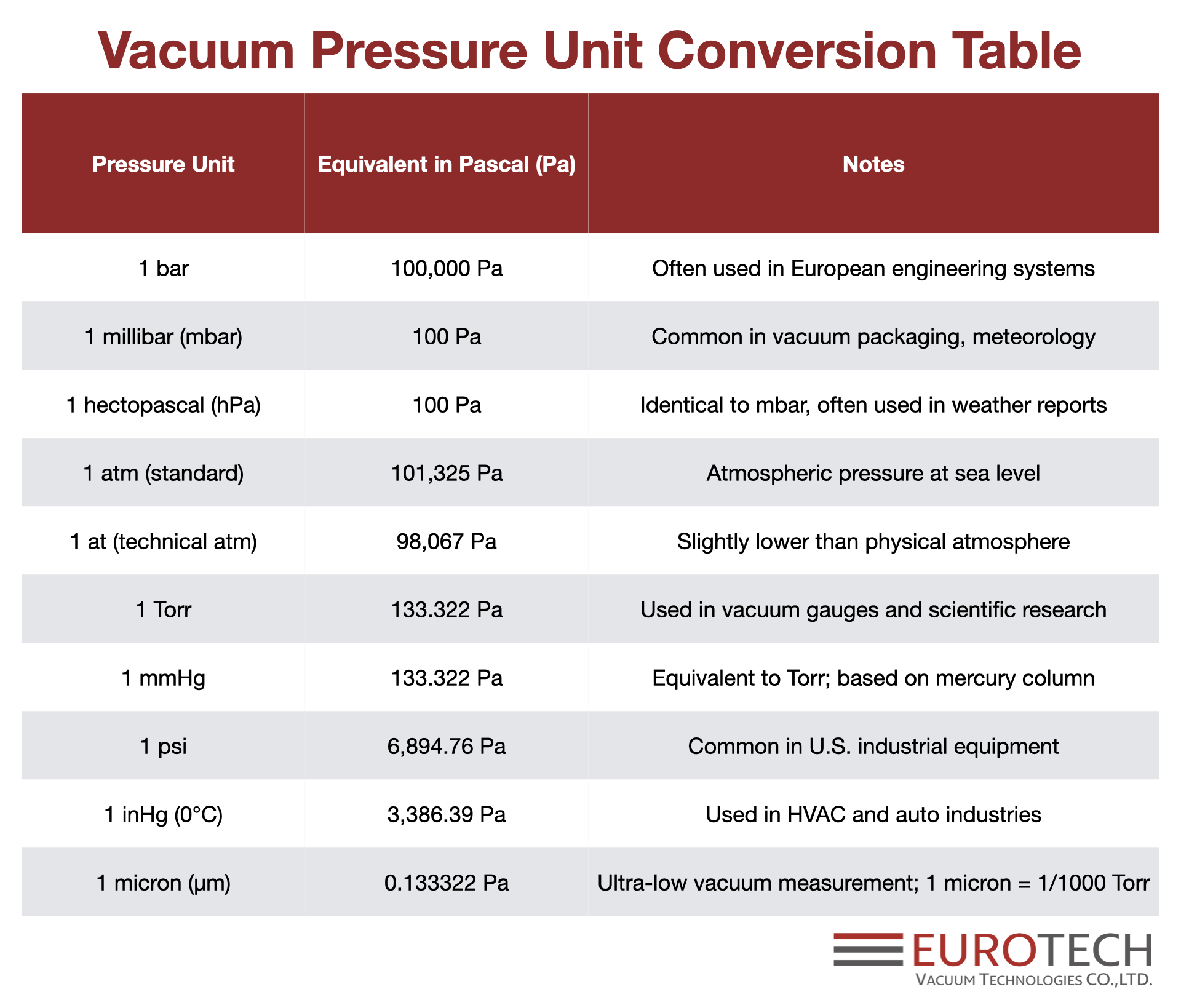
| Pressure unit | Equivalent in Pa | Reference |
|---|---|---|
| 1 bar | 100,000 | Exact |
| 1 mbar | 100 | Exact |
| 1 hPa | 100 | Exact |
| 1 atm | 101,325 | Standard atmosphere, exact |
| 1 at | 98,066.5 | Technical atmosphere |
| 1 Torr | 133.322368 | 1/760 atm, rounded |
| 1 mmHg | 133.3224 | Conventional mercury column, rounded |
| 1 psi | 6,894.757 | Rounded |
| 1 inHg (0 °C) | 3,386.389 | Conventional mercury column, rounded |
| 1 micron Hg | 0.1333224 | One micrometre of mercury, rounded |
Purpose
Use this table to express pressure in pascals for calculation or comparison. A unit conversion keeps the original pressure reference. For example, an absolute reading in inHg converts to an absolute reading in Pa.
For Practical Use
Before comparing gauges, vacuum switch settings or equipment specifications, check whether each value is absolute pressure, signed gauge pressure or a positive vacuum difference. To calculate absolute pressure, add signed gauge pressure to the reference pressure, or subtract the positive vacuum difference from that reference.
How to Use This Vacuum Conversion Chart
- Identify the pressure unit and its reference.
- Find the corresponding factor in the table and multiply by the reading to convert to Pa.
- Divide the result in Pa by 1,000 to express it in kPa, or divide it by the destination unit’s factor to convert it to another unit.
Example calculation: For a reading of 23 inHg absolute, multiply 23 by 3,386.389 Pa per inHg. The result is 77,886.947 Pa absolute, or approximately 77,887 Pa absolute (77.887 kPa absolute). For a reading of 23 inHg vacuum, interpret the value as a pressure difference below the instrument’s atmospheric reference before calculating absolute pressure.
Frequently Asked Questions: Vacuum Unit Conversion
What is a vacuum conversion chart used for?
A vacuum conversion chart helps engineers and technicians compare pressure values in units such as kPa, Torr, psi and inHg. It is useful when comparing vacuum gauges, checking equipment specifications or troubleshooting a vacuum system.
What is the difference between gauge pressure and absolute pressure in vacuum systems?
Absolute pressure is measured from a perfect vacuum. Gauge pressure is measured relative to the instrument’s atmospheric reference. In the main chart, the inHg vacuum column gives the positive difference below the stated atmospheric reference. The inHg absolute column gives the remaining absolute pressure.
How does vacuum level affect suction cup holding force?
With the same effective suction area, a larger pressure difference increases theoretical normal holding force: F = Δp × A. The allowable load also depends on sealing, leakage, workpiece surface, load direction, acceleration and the required safety factor. Use the manufacturer’s rated data for the complete handling system. See our vacuum cup carrying capacity guide for the calculation method.
How do I measure vacuum suction in my system?
Measure pressure with a vacuum gauge or sensor connected to the suction circuit. Check the instrument’s reference and range before interpreting the reading. See our guide to measuring vacuum suction for measurement and selection considerations.
Where can I find vacuum components for my application?
Browse EUROTECH’s vacuum components or contact our team with the required operating pressure, airflow, workpiece details and handling direction.
More About Vacuum Technology
Need help applying these vacuum values to your system?
Review our carrying capacity guide or contact EUROTECH for an application review.